
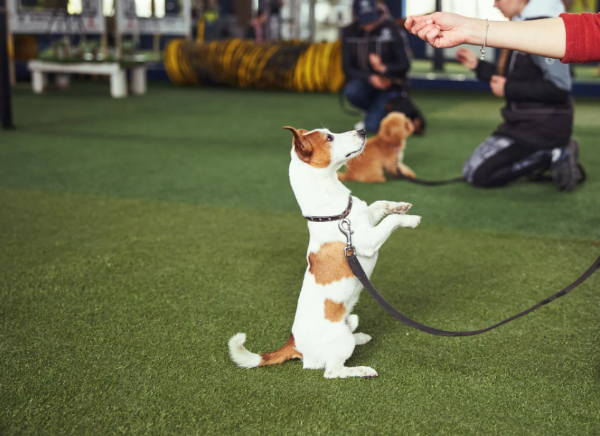
There’s a moment most dog owners recognise. The dog performs beautifully in the training hall, sits on cue, walks reasonably on lead — and then falls apart completely at the park, on a busy street, or the second a visitor walks through the front door. That gap between trained behaviour and real-world behaviour isn’t a dog problem. It’s a generalisation problem, and it almost always traces back to how the training was structured from the beginning. Dog training courses online built around actual learning science close that gap in ways that weekly group classes, through no fault of the instructors, structurally cannot.
The Timing Problem Nobody Discusses
Operant conditioning works on a window that closes fast. A dog offered a reward half a second after the intended behaviour is learning something — just not necessarily what the owner thinks. In a group class, that window gets missed constantly. The instructor is explaining, other dogs are creating distraction, the owner is watching the demonstration instead of watching their dog, and by the time the treat arrives the dog has shifted weight or glanced sideways. Video-based learning that can be paused and replayed changes how quickly owners internalise timing. And timing is where most training either works or quietly falls apart without anyone identifying why.
Why Breed Tendencies Change Everything
Telling a Beagle owner their dog isn’t listening misses the point entirely. Beagles were selectively bred to follow scent independently of human direction — a dog ignoring its nose in favour of handler proximity would have been a poor working prospect for generations. That genetic history doesn’t disappear because someone wants a well-behaved pet. Understanding it changes the training approach completely. Scent becomes a reward rather than a competitor, and the owner stops interpreting breed-typical behaviour as defiance. Dog training courses online built around breed-specific tendencies give owners a framework that explains behaviour before trying to change it — which produces faster results than generic methods applied uniformly across very different dogs.
Reactivity Gets Worse in Group Classes
This is the specific situation where standard group class advice does the most damage. A reactive dog repeatedly placed within sight of other dogs, without a structured desensitisation protocol, isn’t building tolerance. It’s rehearsing the reactive response. Every lunge, every bark, every moment of over-threshold arousal strengthens the neural pathway associated with that trigger. Counter-conditioning requires working below threshold consistently, which means controlling the environment in ways a group class simply cannot accommodate. Dog training courses online addressing reactivity properly teach threshold mechanics and build the owner’s ability to read early arousal signals — the lip lick, the weight shift — before the dog tips into full reaction.
Handler Mechanics Are the Hidden Variable
Research into the human end of the leash consistently shows that handler anxiety transmits through lead tension in ways that prime dogs for reactive responses before any external trigger appears. An owner who tightens the lead when another dog approaches has already communicated that something concerning is happening. The dog responds to the handler’s body before responding to the other dog. Group classes rarely have the bandwidth to observe and correct handler mechanics alongside dog behaviour. Reviewing actual training footage, compared against demonstrated technique, catches these patterns in ways that real-time group instruction almost never manages.
Generalisation Needs Deliberate Structure
A behaviour trained in one location, with one handler, under low distraction is not a trained behaviour. It’s a contextual response. Dogs don’t automatically transfer learning across environments the way humans do. Generalisation requires deliberate exposure to varied contexts and distraction levels in a sequenced way. Most owners don’t know this — which is exactly why their dog’s recall works in the backyard and nowhere else.
Adult Rescue Dogs Need Different Approaches
A rescue dog with an unknown history and established stress responses is not a blank slate that responds to puppy socialisation protocols. Pushing an already anxious dog through standard foundation exercises without addressing the underlying emotional state first produces compliance that looks like training and breaks down under any real pressure. The behaviour holds until it doesn’t — usually at the worst possible moment.
Conclusion
The difference between a dog that performs in training and one that actually behaves in daily life comes down to how the training was understood and applied from the start. Well-designed dog training courses online give owners the learning science, breed-specific context, and handler mechanics to build behaviour that holds up where it actually matters — not just in a controlled class environment on a Tuesday night. For owners who want genuine understanding rather than just surface compliance, that foundation changes everything about the relationship.