
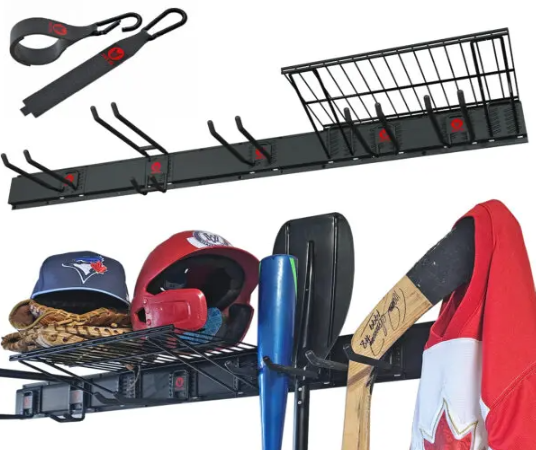
Most Canadians do not actually lose tools — they lose track of where they last put them. The drill ends up near the workbench, the hex keys migrate to a random shelf, and the socket set vanishes entirely around the time winter tyres come out. That slow accumulation of disorder costs real time on real projects. It happens to nearly every garage owner, regardless of how tidy they consider themselves to be. That is precisely why people who buy garage tool organizer in Canada report not just a neater space but a faster workflow — because the friction between thinking and doing disappears when tools are exactly where the hand expects them.
The Hidden Tax of Disorder
There is a concept in productivity called search time — the minutes burned hunting for something before actual work even begins. In a garage, that tax compounds across every single job. A leaking tap, a fence repair, a brake pad swap — each one starts with rummaging through shelves and drawers. Over a full year, that accumulated time adds up to hours nobody budgets for and everyone quietly resents.
Wall Systems Outsmart Drawers
Drawers hide things. That sounds obvious once stated aloud, but most people default to tool chests because they look organised from the outside. Wall-mounted systems — pegboards, slotted panels, magnetic rails — force visibility on everything. When something is missing from its hook, the absence is immediately obvious. A drawer, by contrast, hides the gap entirely until the exact moment the tool is desperately needed mid-job.
Canada’s Freeze-Thaw Problem
Most storage guides skip this entirely because they are written for international audiences. Canadian garages experience temperature swings that crack cheap plastic brackets and warp untreated timber shelving without mercy. An unheated garage in Manitoba or northern Ontario can drop well below freezing overnight, then warm considerably through the day. Powder-coated steel systems handle that cycle reliably. Bargain polymer organisers sold by mass retailers often do not — the hooks turn brittle, and the weight of tools eventually snaps them mid-season when it matters most.
Ceiling Space Nobody Uses
The average single-car garage has considerably more usable ceiling height than its owner ever exploits. Overhead ceiling tracks, typically reserved for kayaks or camping gear, free up substantial floor and wall space once installed properly. Many garage owners discover that after overhead storage goes in, the wall space previously buried under seasonal clutter suddenly opens up for a proper tool wall. The footprint of the garage stays exactly the same. The functional storage area practically doubles.
Modular Beats Fixed Every Time
Fixed custom-built systems look exceptional in renovation magazines. They also lock the owner into a layout that becomes wrong the moment the tool collection grows or shifts direction — and tool collections always grow. Buying a modular garage tool organiser in Canada solves this by allowing panels, hooks, and shelves to shift around without any demolition. The smarter approach is not designing for perfection upfront. It is designed for the inevitable change that comes later.
Organise by Frequency, Not Category
Professional mechanics organise their tools by how often they reach for them, not by what category they belong to. Garages managed the same way perform dramatically better day to day. Tools grabbed regularly sit at arm height, front and centre where hands land naturally. Seasonal items and rarely used speciality tools go high or deep where they stay out of the way. Organising by tool type feels logical on paper until the third time someone crouches down to retrieve a screwdriver they use almost every single day.
The Return Rule Nobody Mentions
Every organised garage eventually drifts back towards chaos without one underappreciated habit — the quick return. Any tool that feels awkward to put away will reliably end up on the nearest flat surface instead of back where it belongs. That is not laziness. That is the system failing its user. Hooks that require two attempts, drawers that stick, labels that are unclear — all of these quietly destroy even the best-intentioned organisation over time. The system has to make returning a tool easier than leaving it out.
Conclusion
A garage that genuinely works is not the result of occasional clean-ups or a single productive Saturday. It comes from storage built around how tools actually get used rather than how a showroom wants them to look. The real return on choosing to buy garage tool organizer in Canada is not tidiness for its own sake — it is starting a job without the usual chaos, moving through it cleanly, and finishing without that familiar sinking feeling that something important has gone missing again.