
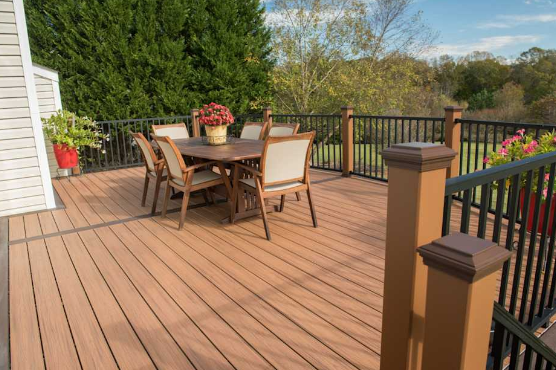
Most homeowners spend weeks choosing kitchen tiles, but hire the first decking contractor they find online. That mismatch in attention is exactly why so many British gardens end up with decks that look tired within a couple of summers — cupped boards, green algae spreading across the surface, and gaps wide enough to swallow a garden fork. The right decking company is not just a convenience; it genuinely determines whether the space works for the next decade or becomes an expensive regret by year three.
Design That Solves Problems
A decent contractor will draw up plans. A good one will notice that the back of your house faces north-east and warn you that certain timber species stay perpetually damp in low-sun gardens, encouraging slippery moss growth. They will spot that the kitchen door swings outward and that your proposed deck level would block it entirely. These are not dramatic discoveries — they are the quiet, experience-based observations that only come from someone who has built enough decks to know what goes wrong. Generic design advice cannot replicate that.
Material Choices Nobody Explains Properly
Composite decking is aggressively advertised as low-maintenance, and that reputation is mostly justified — but the quality gap between cheap composite and premium composite is huge. Cheaper boards might fade unevenly after a few years, particularly in south-facing areas where UV exposure is high. A professional decking firm would explain this rather than merely upsell. They will also warn that hardwoods like Ipe or Cumaru, while gorgeous and thick, require particular fixes to prevent splitting during installation. These are facts brochures leave out, and most internet guides never address sufficiently.
Why Workmanship Shows Up Years Later
The frustrating thing about poor installation is that it often looks perfectly fine on the day. The problems surface gradually. Boards fixed too tightly together with insufficient expansion gaps will buckle in summer heat. Joists installed without adequate ventilation beneath the deck create conditions where rot takes hold within a few years. A skilled tradesperson accounts for timber movement, moisture changes, and load distribution across the frame. None of that is visible on completion day, but all of it determines how the deck ages.
Insurance and Liability Are Not Formalities
Many homeowners treat contractor insurance as a box-ticking exercise. It is not. If an uninsured labourer is injured on your property during construction, liability can fall to the homeowner under certain circumstances. Similarly, if work is carried out without the relevant building consent — some raised decks do require it — the consequences can surface during a property sale years later, stalling conveyancing at the worst possible moment. An established decking company navigates all of this as standard practice, not as an afterthought.
The Resale Angle Most People Underestimate
Buyers go through a garden and make emotional selections within seconds. An obviously well-built deck — uniform board spacing, crisp fascia detail, and robust balustrades — hints that the property has been maintained attentively. Surveyors often mark badly constructed decks as flaws needing corrective work, which offers purchasers grounds to bargain. A deck completed professionally and documented with invoices from a respectable contractor really improves a sale rather than complicating it.
Aftercare Is Where Most Companies Disappear
Ask a contractor before hiring them what happens if a board lifts or a joist fails eighteen months after installation. The answer tells you everything. Established companies offer written guarantees, return calls, and stand behind structural faults without argument. Smaller operations that rely purely on word-of-mouth and have no formal aftercare process often become impossible to reach once the invoice is settled. Ongoing maintenance advice — when to re-oil, which products to avoid, how to handle winter — is part of what a proper professional relationship includes.
Conclusion
Choosing the wrong decking company rarely announces itself immediately. The damage is slow, cumulative, and almost always more expensive to fix than the original saving was worth. A contractor who asks the right questions, explains material trade-offs honestly, and builds with the long game in mind is the one worth hiring. That kind of professional does not just construct a deck — they remove the future headaches that most homeowners do not even know to anticipate.